Showing posts with label sports. Show all posts

The GAME Training: Herschel Walker’s Advanced Workout, Week Seven

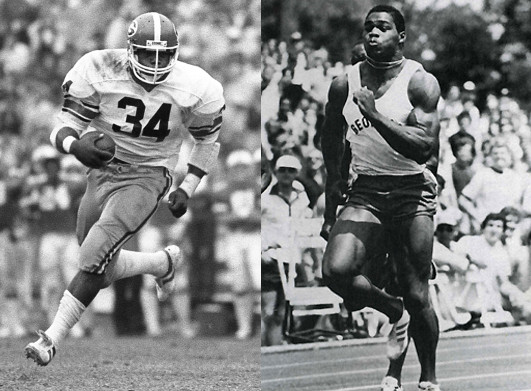
Herschel Walker georgia football track athlete.

Here is week seven of Herschel Walker’s recommended advanced workout from his book, Herschel Walker’s Basic Training.

Week One | Week Two | Week Three | Week Four | Week Five | Week Six

THE ADVANCED PROGRAM

WEEK SIX: Monday, Friday—Morning Session

Warm-ups: 35 jumping jacks. Run in place for 4 minutes.

Stretching: Hold each stretch twice for 30 seconds.

Jogging: 14 minutes.

Karate:

Straight punch—42 per arm
Groin strike—42 per arm
Open-hand strike to face—42 per arm
Roundhouse kick—42 per leg
Front snap kick to the midsection—42 per leg
Front snap kick to the head—42 per leg
Sliding back kick—42 per leg
Agility:
Squat thrust—50
Sideways box hop—65
Backward and forward box hop—65
Half-turn—65

Push-ups: 130 total. Do as many as possible, rest, then continue until the entire number has been completed. Make sure you experiment with different heights to change the resistance.

Sit-ups: 160 total. Add weight if needed.

Stretching: Hold each stretch twice for 30 seconds.

Monday, Friday—Afternoon Session

Warm-ups: 35 jumping jacks. Run in place for 4 minutes.

Stretching: Hold each stretch twice for 30 seconds.

Jogging: 4 minutes.

Weight training:

Power pull—1 x10 warm-up, 3 x 5 target weight, 1 x 10 with 70% of target
Squat—1 x 10 warm-up, 3 x 5 target weight, 1 x 10 with 70% of target
Bench press—1 x 10 warm-up, 3 x 5 target weight, 1 x 10 with 70% of target
Close-grip bench press—1 x 10 warm-up, 3 x 5 target weight, 1 x 10 with 70% of target
Bent-forward row—1 x 10 warm-up, 3 x 5 target weight, 1 x 10 with 70% of target
Crunch—110
Twisting sit-up—90

Basketball: 45 minutes

Stretching: Hold each stretch twice for 30 seconds.

Wednesday

Wednesday’s workouts should be identical to those of Monday and Friday except for the weight work in the afternoon. Follow this program on Wednesday for your lifting:

Weight training:

Lunge—1 x 10 warm-up, 3 x 5 target weight, 1 x 10 with 70% of target
Chin—1 x 10, 3 x 5 with added weight, 1 x 10
Curl—1 x 10 warm-up, 3 x 5 target weight, 1 x 10 with 70% of target
Triceps press—1 x 10 warm-up, 3 x 5 target weight, 1 x 10 with 70% of target
Weighted sit-up—4 x 25
Leg raise—110

Tuesday, Saturday—Morning Session

Warm-ups: 35 jumping jacks. Run in place for 4 minutes.

Stretching: Hold each stretch twice for 30 seconds.

Jogging: 6 minutes.

Sprinting: 2 x 440-yard strides (half speed). 2 x 300-yard strides (three-quarter speed). 2 x 200-yard strides. 2 x 110-yard sprints.

Hill running: 9 x 30-yard strides (half to three-quarter speed).

Dumbbell runs: 5 x 30-yard strides. Make sure to use light dumbbells for this and concentrate on arm position as you run.

Rope skipping: 15 minutes.

Stretching: Hold each stretch twice for 30 seconds.

Tuesday, Saturday—Afternoon Session

Warm-ups: 35 jumping jacks. Run in place for 4 minutes.

Stretching: Hold each stretch twice for 30 seconds.

Karate:

Straight punch—42 per arm
Groin strike—42 per arm
Open-hand strike to face—42 per arm
Roundhouse kick—42 per leg
Front snap kick to the midsection—42 per leg
Front snap kick to the head—42 per leg
Sliding back kick—42 per leg

Basketball: 45 minutes.

Water work:

Run in water—14 minutes
Water karate (kicks and punches)—14 minutes
Modified breast stroke—14 minutes
Power clap and other shoulder and arm work—14 minutes
Stretching: Hold each stretch twice for 30 seconds.

Thursday
Morning and afternoon workouts should be identical to those of Tuesday and Saturday except for the sprinting portion of the morning session. On Thursday mornings substitute the tire pull for hill running. On this seventh week run 9 x 50-yard strides at half speed, pulling a tire with 15 to 20 pounds inside it. Then, rather than dumbbell sprints, wear a weighted vest and run 5 x 100-yard strides.

The GAME Training: Why Centering and Grounding Are the Real First Steps in Sports Mastery

In the rush to master the latest techniques, perfect our mechanics, or dive into a new training regimen, it’s easy to overlook the most critical phase of athletic development: centering and grounding. If you're rebooting your approach to sports performance—whether you're an athlete, coach, or student of the game—this concept isn't just philosophical fluff. It's the bedrock for any sustainable, high-performance journey.

As we relaunch this training and strategy blog, it feels only right to begin not with drills or systems, but with mindset and self-awareness—the internal mechanics that too often go untrained.

What Does “Centering and Grounding” Really Mean?

In both Eastern practices and modern sports psychology, centering refers to the process of aligning mind and body into a state of calm, focused readiness. Grounding, on the other hand, is about establishing a stable connection with the present moment, your environment, and your own physical sensations.

Together, centering and grounding create a foundation of clarity and composure—especially under stress. Whether you're preparing to learn a complex movement pattern or making a game-time decision under pressure, that internal steadiness can mean the difference between mastery and inconsistency.

Let’s break it down further.

Why Athletes Struggle Without a Grounded Foundation

When athletes leap straight into high-volume training or complex techniques without laying this groundwork, common issues arise:

  • Mental fatigue: Without the tools to reset mentally, athletes burn out faster.

  • Injury risk: Lack of bodily awareness leads to poor mechanics and overtraining.

  • Stagnation: Plateaus aren’t always physical—sometimes the nervous system and mindset just aren’t prepared for more.

  • Overwhelm: Juggling multiple systems, coaches, and training demands becomes chaotic without a central point of focus.

In other words: you can’t build a skyscraper on sand.

The Neurological and Psychological Angle

Sports performance is increasingly recognized as a neuro-physical endeavor. Movement, balance, reaction time, decision-making—all of it is dictated by the nervous system. If your system is dysregulated—e.g., stuck in fight-or-flight mode—you won’t absorb coaching as effectively, nor will you adapt to training with consistency.

Centering activates the parasympathetic nervous system, promoting calm and focus. Grounding enhances proprioception—your body’s sense of where it is in space. Combined, they make your body more “trainable” and your mind more coachable.

How to Practice Centering and Grounding (Practically Speaking)

Here are techniques that athletes at any level can incorporate into their daily routines:

1. Breathwork Before Practice
  • Simple drill: 4-4-8 breathing (inhale for 4, hold for 4, exhale for 8).

  • Why it matters: Resets the nervous system, reducing anxiety and increasing focus.

2. Body Scan Awareness
  • Spend 60 seconds mentally scanning your body from head to toe before training.

  • Why it matters: Enhances body awareness, identifies tension or imbalance.

3. Anchoring Rituals
  • A pre-practice or pre-game routine (tying shoes a certain way, a specific warmup song, tapping a specific spot on your body) creates mental familiarity and stability.

  • Why it matters: Creates a sense of “home” and presence no matter where you are.

4. Grounding Through the Senses
  • Briefly tune into each sense: What do you hear, see, feel, smell, taste?

  • Why it matters: Pulls attention away from future worries or past failures and into the now.

When Centering Becomes Second Nature

Here’s the real beauty of centering and grounding: once internalized, they stay with you. They become portable skills—usable during timeouts, between reps, or in the seconds before a serve, a swing, or a sprint. The more chaotic the environment, the more they shine.

Consider how elite athletes stay composed under bright lights. It’s not magic—it’s practiced self-regulation. They’ve trained their nervous systems and internal narratives just as intensely as their bodies.

Training for Complexity Starts with Simplicity

Before you tackle sport-specific systems, tactical complexity, or advanced biomechanics, commit to the simplest discipline of all: awareness. An uncentered athlete will misinterpret coaching cues, misjudge spacing, and second-guess decisions. A grounded athlete, on the other hand, learns faster, adapts better, and executes with clarity.

As we explore sports training in deeper layers—strength & conditioning, recovery, skill acquisition, game theory—we’ll return again and again to this internal compass. Because rebooting your game isn’t just about leveling up your workouts; it’s about recalibrating how you relate to the work itself.

So take a breath. Feel your feet. Before you rush forward, go inward. That’s where real performance begins.

Ready to Reboot?

In upcoming posts, we’ll dive into progressive training strategies, mental performance tools, and sport-specific systems. But always remember: the best strategy is useless without a centered mind and grounded body to execute it.

Let this be the new starting line.

THE GAME Training: Herschel Walker’s Advanced Workout, Week Six

Here is week six of Herschel Walker’s recommended advanced workout from his book, Herschel Walker’s Basic Training.

Week One | Week Two | Week Three | Week Four | Week Five

THE ADVANCED PROGRAM

WEEK SIX: Monday, Friday—Morning Session

Warm-ups: 30 jumping jacks. Run in place for 4 minutes.

Stretching: Hold each stretch twice for 30 seconds.

Jogging: 13 minutes.

Karate:
Straight punch—40 per arm
Groin strike—40 per arm
Open-hand strike to face—40 per arm
Roundhouse kick—40 per leg
Front snap kick to the midsection—40 per leg
Front snap kick to the head—40 per leg
Sliding back kick—40 per leg
Agility:
Squat thrust—50
Sideways box hop—60
Backward and forward box hop—60
Half-turn—60
Push-ups: 125 total. Do as many as possible, rest, then continue until all 125 have been done. Make sure you experiment with different heights to change the resistance.

Sit-ups: 150 total. Add weight if needed.

Stretching: Hold each stretch twice for 30 seconds.

Monday, Friday—Afternoon Session

Warm-ups: 35 jumping jacks. Run in place for 4 minutes.

Stretching: Hold each stretch twice for 30 seconds.

Jogging: 4 minutes.

Weight training:
Power pull—1 x10 warm-up, 3 x 5 target weight, 1 x 10 with 70% of target
Squat—1 x 10 warm-up, 3 x 5 target weight, 1 x 10 with 70% of target
Bench press—1 x 10 warm-up, 3 x 5 target weight, 1 x 10 with 70% of target
Close-grip bench press—1 x 10 warm-up, 3 x 5 target weight, 1 x 10 with 70% of target
Bent-forward row—1 x 10 warm-up, 3 x 5 target weight, 1 x 10 with 70% of target
Crunch—105
Twisting sit-up—85
Basketball: 45 minutes

Stretching: Hold each stretch twice for 30 seconds.

Wednesday

Wednesday’s workouts should be identical to those of Monday and Friday except for the weight work in the afternoon. Follow this program on Wednesday for your lifting:

Weight training:
Lunge—1 x 10 warm-up, 3 x 5 target weight, 1 x 10 with 70% of target
Chin—1 x 10, 3 x 5 with added weight, 1 x 10
Curl—1 x 10 warm-up, 3 x 5 target weight, 1 x 10 with 70% of target
Triceps press—1 x 10 warm-up, 3 x 5 target weight, 1 x 10 with 70% of target
Weighted sit-up—4 x 25
Leg raise—100
Tuesday, Saturday—Morning Session

Warm-ups: 35 jumping jacks. Run in place for 4 minutes.

Stretching: Hold each stretch twice for 30 seconds.

Jogging: 6 minutes.

Sprinting: 1 x 880-yard stride (quarter to half speed). 2 x 440-yard strides (half speed). 2 x 300-yard strides (three-quarter speed). 2 x 200-yard sprints.

Hill running: 8 x 40-yard strides (half speed).

Dumbbell runs: 5 x 30-yard strides. Make sure to use light dumbbells for this and concentrate on arm position as you run.

Rope skipping: 15 minutes.

Stretching: Hold each stretch twice for 30 seconds.

Tuesday, Saturday—Afternoon Session

Warm-ups: 35 jumping jacks. Run in place for 4 minutes.

Stretching: Hold each stretch twice for 30 seconds.

Karate:
Straight punch—40 per arm
Groin strike—40 per arm
Open-hand strike to face—40 per arm
Roundhouse kick—40 per leg
Front snap kick to the midsection—40 per leg
Front snap kick to the head—40 per leg
Sliding back kick—40 per leg
Basketball: 45 minutes.

Water work:
Run in water—14 minutes
Water karate (kicks and punches)—14 minutes
Modified breast stroke—14 minutes
Power clap and other shoulder and arm work—14 minutes
Stretching: Hold each stretch twice for 30 seconds.

Thursday

Morning and afternoon workouts should be identical to those of Tuesday and Saturday except for the sprinting portion of the morning session. On Thursday mornings substitute the tire pull for hill running. On this sixth week run 8 x 50-yard strides at half speed, pulling a tire with 12 to 15 pounds inside it. Then, rather than dumbbell sprints, wear a weighted vest and run 1 x 200-yard stride at half to three-quarter speed and 4 x 100-yard strides.

THE GAME Training: Herschel Walker’s Advanced Workout, Week Five

herschel walker MMA2
Here is week five of Herschel Walker’s recommended advanced workout from his book, Herschel Walker’s Basic Training.

Week One | Week Two | Week Three | Week Four

THE ADVANCED PROGRAM

WEEK FIVE: Monday, Friday—Morning Session

Warm-ups: 30 jumping jacks. Run in place for 4 minutes.

Stretching: Hold each stretch twice for 30 seconds.

Jogging: 12 minutes.

Karate:
Straight punch—38 per arm
Groin strike—38 per arm
Open-hand strike to face—38 per arm
Roundhouse kick—38 per leg
Front snap kick to the midsection—38 per leg
Front snap kick to the head—38 per leg
Sliding back kick—38 per leg
Agility:
Squat thrust—45
Sideways box hop—55
Backward and forward box hop—55
Half-turn—55
Push-ups: 120 total. Do as many as possible, rest, then continue until all 120 have been done. If these are too easy, elevate your feet at least 8 inches.

Sit-ups: 140 total. Again add weight if needed.

Stretching: Hold each stretch twice for 30 seconds.

Monday, Friday—Afternoon Session

Warm-ups: 35 jumping jacks. Run in place for 4 minutes.

Stretching: Hold each stretch twice for 30 seconds.

Jogging: 4 minutes.

Weight training:
Power pull—1 x10 warm-up, 3 x 5 target weight, 1 x 10 with 70% target
Squat—1 x 10 warm-up, 3 x 5 target weight, 1 x 10 with 70% target
Bench press—1 x 10 warm-up, 3 x 5 target weight, 1 x 10 with 70% target
Close-grip bench press—1 x 10 warm-up, 3 x 5 target weight, 1 x 10 with 70% target
Bent-forward row—1 x 10 warm-up, 3 x 5 target weight, 1 x 10 with 70% target
Crunch—100
Twisting sit-up—80
Basketball: 40 minutes

Stretching: Hold each stretch twice for 30 seconds.

Wednesday

Wednesday’s workouts should be identical to those of Monday and Friday except for the weight work in the afternoon. Follow this program on Wednesday for your lifting:

Weight training:
Lunge—1 x 10 warm-up, 3 x 5 target weight, 1 x 10 with 70% target
Chin—1 x 10, 3 x 5 with added weight
Curl—1 x 10 warm-up, 3 x 5 target weight, 1 x 10 with 70% target
Triceps press—1 x 10 warm-up, 3 x 10 target weight, 1 x 10 with 70% target
Weighted sit-up—4 x 20
Leg raise—90
Tuesday, Saturday—Morning Session

Warm-ups: 35 jumping jacks. Run in place for 4 minutes.

Stretching: Hold each stretch twice for 30 seconds.

Jogging: 6 minutes.

Sprinting: 2 x 880-yard strides (quarter to half speed). 2 x 440-yard strides (half speed). 2 x 300-yard strides (three-quarter speed). 1 x 200-yard sprint.

Hill running: 7 x 40-yard strides (half speed).

Dumbbell runs: 5 x 30-yard strides. Make sure to use light dumbbells for this and concentrate on arm position as you run.

Rope skipping: 14 minutes.

Stretching: Hold each stretch twice for 30 seconds.

Tuesday, Saturday—Afternoon Session

Warm-ups: 35 jumping jacks. Run in place for 4 minutes.

Stretching: Hold each stretch twice for 30 seconds.

Karate:
Straight punch—38 per arm
Groin strike—38 per arm
Open-hand strike to face—38 per arm
Roundhouse kick—38 per leg
Front snap kick to the midsection—38 per leg
Front snap kick to the head—38 per leg
Sliding back kick—38 per leg
Basketball: 45 minutes.

Water work:
Run in water—14 minutes
Water karate (kicks and punches)—14 minutes
Modified breast stroke—14 minutes
Power clap and other shoulder and arm work—14 minutes
Stretching: Hold each stretch twice for 30 seconds.

Thursday

Morning and afternoon workouts should be identical to those of Tuesday and Saturday except for the sprinting portion of the morning session. On Thursday mornings substitute the tire pull for hill running. On this fifth week run 7 x 50-yard strides at half speed, pulling a tire with 12 to 15 pounds inside it. Then, rather than dumbbell sprints, wear a weighted vest and run 2 x 200-yard strides at half to three-quarter speed and 3 x 100-yard strides.

THE GAME Training: Herschel Walker’s Advanced Workout, Week Four

Greg Nagy vs Herschel Walker
Here is week four of Herschel Walker’s recommended advanced workout from his book, Herschel Walker’s Basic Training.

Week One | Week Two | Week Three

THE ADVANCED PROGRAM

WEEK FOUR: Monday, Friday—Morning Session

Warm-ups: 35 jumping jacks. Run in place for 4 minutes.

Stretching: Hold each stretch twice for 30 seconds.

Jogging: 11 minutes.

Karate:
Straight punch—34 per arm
Groin strike—34 per arm
Open-hand strike to face—34 per arm
Roundhouse kick—34 per leg
Front snap kick to the midsection—34 per leg
Front snap kick to the head—34 per leg
Sliding back kick—34 per leg
Agility:
Squat thrust—40
Sideways box hop—50
Backward and forward box hop—50
Half-turn—50
Push-ups: 110 total. Do as many as possible, rest, then continue until the entire number has been completed. If these are too easy, elevate the feet.

Sit-ups: 130 total. Add extra weight if you can do these easily.

Stretching: Hold each stretch twice for 30 seconds.

Monday, Friday—Afternoon Session

Warm-ups: 35 jumping jacks. Run in place for 4 minutes.

Stretching: Hold each stretch twice for 30 seconds.

Jogging: 4 minutes.

Weight training:
Power pull—1 x10 warm-up, 3 x 10 target weight
Squat—1 x 10 warm-up, 3 x 10 target weight
Bench press—1 x 10 warm-up, 3 x 10 target weight
Close-grip bench press—1 x 10 warm-up, 3 x 10 target weight
Bent-forward row—1 x 10 warm-up, 3 x 10 target weight
Crunch—95 (break into sets if necessary)
Twisting sit-up—75 (break into sets if necessary)
Basketball: 35 minutes

Stretching: Hold each stretch twice for 30 seconds.

Wednesday

Wednesday’s workouts should be identical to those of Monday and Friday except for the weight work in the afternoons. Follow this program on Wednesday for your lifting:

Weight training:
Lunge—1 x 10 warm-up, 3 x 10 target weight
Chin—3 x 10, 1 set to failure
Curl—1 x 10 warm-up, 3 x 10 target weight
Triceps press—1 x 10 warm-up, 3 x 10 target weight
Weighted sit-up—3 x 20 (increase weight if possible)
Leg raise—80
Tuesday, Saturday—Morning Session

Warm-ups: 35 jumping jacks. Run in place for 4 minutes.

Stretching: Hold each stretch twice for 30 seconds.

Jogging: 6 minutes.

Sprinting: 2 x 880-yard strides (quarter to half speed). 2 x 440-yard strides (half speed). 2 x 300-yard strides (three-quarter speed)

Hill running: 6 x 40-yard strides (half speed).

Dumbbell runs: 5 x 30-yard strides. Make sure to use light dumbbells for this and concentrate on arm position as you run.

Rope skipping: 13 minutes.

Stretching: Hold each stretch twice for 30 seconds.

Tuesday, Saturday—Afternoon Session

Warm-ups: 35 jumping jacks. Run in place for 4 minutes.

Stretching: Hold each stretch twice for 30 seconds.

Karate:
Straight punch—34 per arm
Groin strike—34 per arm
Open-hand strike to face—34 per arm
Roundhouse kick—34 per leg
Front snap kick to the midsection—34 per leg
Front snap kick to the head—34 per leg
Sliding back kick—34 per leg
Basketball: 45 minutes.

Water work:
Run in water—12 minutes
Water karate (kicks and punches)—12 minutes
Modified breast stroke—12 minutes
Power clap and other shoulder and arm work—12 minutes
Stretching: Hold each stretch twice for 30 seconds.

Thursday

Morning and afternoon workouts should be identical to those of Tuesday and Saturday except for the sprinting portion of the morning session. On Thursday mornings substitute the tire pull for hill running. On this fourth week run 6 x 50-yard strides at half speed, pulling a tire with 12 to 15 pounds inside it. Then, rather than dumbbell sprints, wear a weighted vest and run 3 x 200-yard strides at half to three-quarter speed and 2 x 100-yard strides.

The First Basic GAME Formations, Circa 1999…Updated 2009-10, Part One

Back in 2000, I slotted, what were then, contemporary players into the various formation modules based on the players’ skill sets and what the positions’ requirements were. I thought it would be fun to revisit the first post about GAME formations by inserting recent players into the formations while detailing the needs of each position some more.

The following depth chart is for the power-speed formation module at the top of the diagram. You may notice that some of the players no longer play on the team listed next their name. Some of the players may not fit their current team as well as they did on their previous team; in these instances we have designated the team and the system that the listed player was more suited to play.

GAME-Blue-Formation-1

Module #1 power-speed formation depth chart:

SCDeron Williams (G, Utah Jazz), Kaká (MF, Real Madrid). This module’s position requires a strong decision maker with size, strength, quickness and the ability to distribute the ball precisely. The decisions that the SC make are based on the alignment and/or (expected) degree of penetration by the defense. Reacting to the defensive alignment, the SC will distribute the ball to the ThB’s in the rear, pass or lateral to the outside wings where wing playmakers (W) are aligned within separate wing modules, or keep the ball to achieve forward progress. Next in line: Derrick Rose (G, Chicago Bulls).

ThB: Tim Tebow (QB, University of Florida), Dan LeFevour (QB, Central Michigan University). This position requires a player who has the rare ability to accurately make all throws or kicks, run with elusiveness and run with power. Power is important in this position since the defense is aligned in close proximity. This ThB can either block/guard larger defenders, receive the ball and accurately distribute to ThB’s behind or to playmakers on the wings, or keep the ball to achieve forward progress. Next in line: Cam Newton (QB, Auburn University).

ThB: Terrelle Pryor (QB, Ohio State University), Dan Carter (Fly-half, USA Perpignan and the Crusaders), Juice Williams (QB, University of Illinois), . This position is similar to the ThB previously described, but throwing is not as essential of a requirement. The ability to pass or kick forward at this position is important in order to keep the defense off balance, but the majority of the time these ThB’s will keep the ball or distribute the ball laterally to a teammate. As a result, these ThB’s must have power, elusiveness and speed. Next in line: Jordan Reed (QB, University of Florida).

ThB: Boris Diaw (F/C, Charlotte Bobcats), Pau Gasol (C, Los Angeles Lakers). Diaw and Gasol are considered two of the best passing/outlet passing athletic big men in basketball. The primary physical attribute necessary for this position is size. As ThB’s are positioned further behind the frontline, visualizing the action on the field becomes more challenging. That is why it is necessary to have an excellent passing big man with good decision making skills positioned in the middle of the ThB formation to do the following: read the defensive formation and movement; analyze the progress of the ThB’s in the front (against the defense); adjust the call/play or continue with the planned call/play based on the two main reads; pass to the appropriate playmakers based on the reads. Next in line: Kevin Love (C, Minnesota Timberwolves).

ThB: Pat White (QB, Miami Dolphins), Seneca Wallace (QB, Seattle Seahawks). The next two rows of ThB’s are the best combination of speed, quickness and arm strength (or kicking accuracy with distance). Agile and elusive, these ThB’s can make plays with their game-breaking speed, with their arm strength or with their feet (if they are passing or scoring with kicks at the goal). They can get the ball to playmakers positioned on the wings, launch balls to playmakers in other nodes or dart into/out of nodes by using their speed to slice through zones.

ThB: Michael Vick (QB, Philadelphia Eagles), Denard Robinson (QB, University of Michigan). Next in line: Jonathan Brown (Centre half-forward, Brisbane Lions), Matthew Pavlich (Centre half-forward, Fremantle).

ThB: Donovan McNabb (QB, Philadelphia Eagles), Jay Cutler (QB, Chicago Bears. The next two rows of ThB’s have the best arms. This row has better movement and elusiveness than the following row; speed is not an essential attribute but a plus. The ability to throw the ball into other nodes and across zones is essential. Although these ThB’s may not have speed, they should have good lateral movement in order to laterally mirror the movements of ThB’s in the front rows (in the event ThB’s in front lateral, pass or kick to them) and the ability to laterally track the ThB’s behind them (in order to lateral, pass or kick to them). Next in line: Andrew Luck (QB, Stanford University).

…ThB: Ben Roethlisberger (QB, Pittsburgh Steelers), Joe Flacco (QB, Baltimore Ravens). Also known as “Towers” or “Throwers”, these ThB’s have size, strength and superb arm strength. Their goal is to fire balls to participants in other nodes, across zones or on the wings: to transition play into other nodes and zones; to advance the offense in their own zone of play. They may not exactly mirror the movements of the ThB’s in the front rows, but they must remain in the zone of action in order to receive a lateral, pass or kick. Next in line: Ryan Mallett (QB, University of Arkansas).

Using Release Moves Against a Bump and Run Defender on the Wings

Ron Jenkins explains the various release moves that a receiver has at his disposal when encountering a bump and run defender. Although this video directly applies to football WR play, much of this can and should be applied to GAME W play in the internodal transition zones on the wings.

As the distance between a SC, ThB or QB and his target increases, timing becomes more critical as the ball is thrown to a spot rather than “at the receiver”. The ability of a W to master several of these release moves will allow him to get into his pattern faster and get to his spot faster in order to receive the ball:

THE GAME Training: Herschel Walker’s Advanced Workout, Week Three

ESPN-Body-Issue-2010-Herschel-Walker
Photo courtesy of ESPN Magazine Body Issue 2010
Here is week three of Herschel Walker’s recommended advanced workout from his book, Herschel Walker’s Basic Training.

Week One | Week Two

THE ADVANCED PROGRAM

WEEK THREE: Monday, Friday—Morning Session

Warm-ups: 30 jumping jacks. Run in place for 4 minutes.

Stretching: Hold each stretch twice for 30 seconds.

Jogging: 10 minutes.

Karate:
Straight punch—30 per arm
Groin strike—30 per arm
Open-hand strike to face—30 per arm
Roundhouse kick—30 per leg
Front snap kick to the midsection—30 per leg
Front snap kick to the head—30 per leg
Sliding back kick—30 per leg
Agility:
Squat thrust—35
Sideways box hop—45
Backward and forward box hop—45
Half-turn—45

Push-ups: 100 total. Do as many as possible, rest, then continue until all 100 have been done. If these are easy, elevate your feet at least 8 inches.

Sit-ups: 120 total. Try to do these as 2 sets. If you can do these easily, hold a small weight behind your head to increase the resistance.

Stretching: Hold each stretch twice for 30 seconds.

Monday, Friday—Afternoon Session

Warm-ups: 30 jumping jacks. Run in place for 4 minutes.

Stretching: Hold each stretch twice for 30 seconds.

Jogging: 4 minutes.

Weight training:
Power pull—1 x10 warm-up, 3 x 10 target weight
Squat—1 x 10 warm-up, 3 x 10 target weight
Bench press—1 x 10 warm-up, 3 x 10 target weight
Close-grip bench press—1 x 10 warm-up, 3 x 10 target weight
Bent-forward row—1 x 10 warm-up, 3 x 10 target weight
Crunch—85 (break into sets if necessary)
Twisting sit-up—70 (break into sets if necessary)
Basketball: 30 minutes

Stretching: Hold each stretch twice for 30 seconds.

Wednesday

Wednesday’s workouts should be identical to those of Monday and Friday except for the weight work in the afternoon. Follow this program on Wednesday for your lifting:

Weight training:
Lunge—1 x 10 warm-up, 3 x 10 target weight
Chin—3 x 10, 1 set to failure
Curl—1 x 10 warm-up, 3 x 10 target weight
Triceps press—1 x 10 warm-up, 3 x 10 target weight
Weighted sit-up—3 x 20
Leg raise—70
Tuesday, Saturday—Morning Session

Warm-ups: 30 jumping jacks. Run in place for 4 minutes.

Stretching: Hold each stretch twice for 30 seconds.

Jogging: 5 minutes.

Sprinting: 3 x 880-yard strides (quarter to half speed). 2 x 440-yard strides (half speed). 1 x 300-yard stride (three-quarter speed)

Hill running: 5 x 40-yard strides (half speed).

Dumbbell runs: 4 x 30-yard strides. Make sure to use light dumbbells for this and concentrate on arm position as you run.

Rope skipping: 12 minutes.

Stretching: Hold each stretch twice for 30 seconds.

Tuesday, Saturday—Afternoon Session

Warm-ups: 30 jumping jacks. Run in place for 4 minutes.

Stretching: Hold each stretch twice for 30 seconds.

Karate:
Straight punch—30 per arm
Groin strike—30 per arm
Open-hand strike to face—30 per arm
Roundhouse kick—30 per leg
Front snap kick to the midsection—30 per leg
Front snap kick to the head—30 per leg
Sliding back kick—30 per leg
Basketball: 40 minutes.

Water work:
Run in water—10 minutes
Water karate (kicks and punches)—10 minutes
Modified breast stroke—10 minutes
Power clap and other shoulder and arm work—10 minutes
Stretching: Hold each stretch twice for 30 seconds.

Thursday

Morning and afternoon workouts should be identical to those of Tuesday and Saturday except for the sprinting portion of the morning session. On Thursday mornings substitute the tire pull for hill running. On this third week run 5 x 50-yard strides at half speed, pulling a tire with 12 to 15 pounds inside it. Then, rather than dumbbell sprints, wear a weighted vest and run 4 x 200-yard strides at half to three-quarter speed.

THE GAME Training: A Compilation of Jerry Rice’s Workout Routines

Legendary NFL wide receiver Jerry Rice is known for his arduous offseason training regimen as much as his stellar Hall of Fame career on the field. But, surprisingly there is very little detailed information on the internet outlining his complete strength and conditioning program. Much of what we know is general information that does not get into specific numbers of sets or repetitions (like this video of Jerry Rice’s legendary Hill runs).

In order to create a reliable and accessible resource, the following links to Jerry Rice’s offseason strength and conditioning programs have been compiled listing specific routines, exercises, sets or repetitions. If there is anything that can be added to this list please leave a link in the comments section below and we will add them to this list.

From Outside Magazine:

Rice's six-day-a-week workout is divided into two parts: two hours of cardiovascular work in the morning and three hours of strength training each afternoon. Early in the off-season, the a.m. segment consists of a five-mile trail run near San Carlos on a torturous course called, simply, The Hill. But since five vertical miles can hardly be considered a workout, he pauses on the steepest section to do a series of ten 40-meter uphill sprints. As the season approaches, however, Rice knows it's time to start conserving energy — so he forgoes The Hill and instead merely does a couple of sprints: six 100-yarders, six 80s, six 60s, six 40s, six 20s, and 16 tens, with no rest between sprints and just two and a half minutes between sets.

For the p.m. sessions he alternates between upper-body and lower-body days. But no matter which half of his body he's working on, the volume is always the same: three sets of ten reps of 21 different exercises. Yes, your calculator's right: That's 630 repetitions a day.

From The New York Times:

Tiny puddles begin to form on the track at Menlo College in Atherton, about 20 miles south of San Francisco, and the participants in Rice's workout -- one of them a reporter -- step through them while doing 20 minutes of stretching and warm-ups. Leading the workout is Rice's trainer, Raymond Farris, who has worked with Rice for nine years and helped him become the hardest working player in the league and arguably the best receiver ever in the National Football League…

After the warm-ups, the workout shifts to the football field, where Farris has set up a series of cones for the running exercises. The sprints are called "accelerators." One cone is set up 20 yards downfield and the runners build up steam until they reach the cone. The group then sprints full speed for 60 yards until the next cone, which is the signal to downshift for 20 yards. Rice eventually does 14 of these, each one in perfect form, each one at 100 percent, with no rest in between…

Usually the group will run for another hour or so, scampering up hills, sprinting through agility drills. They also do "pyramids," which are full-speed sprints for 100 yards, then 90 yards, then 80, all the way down to 20…

From JerryRiceFootball.com

STRENGTH TRAINING

LEG EXERCISES

  • ANGLED LEG PRESS
  • BARBELL LUNGES
  • CALF PRESSES
  • DUMBBELL LUNGES
  • DUMBBELL SQUATS
  • FRONT SQUATS
  • HACK SQUATS
  • LEG EXTENSIONS
  • LYING LEG CURLS
  • SEATED CALF RAISES
  • SMITH MACHINE SQUATS
  • SQUATS
  • STANDING DUMBBELL CALF RAISES
  • STIFF-LEGGED DEADLIFTS

EXAMPLE LEG ROUTINES

ROUTINE 1

  • SQUATS (your choice)
  • LEG EXTENSIONS
  • LYING LEG CURLS
  • CALF RAISES (seated or standing)

ROUTINE 2

  • HACK SQUATS
  • ANGLED LEG PRESS
  • STIFF-LEGGED DEAD LIFTS
  • CALF RAISES (seated or standing)

ROUTINE 3

  • ANGLED LEG PRESS
  • CALF PRESSES
  • LEG EXTENSIONS
  • LYING LEG CURLS

ROUTINE 4

  • SQUATS (your chioce)
  • LUNGES (your choice)
  • LYING LEG CURLS (your choice)
  • CALF RAISES (seated or standing)

ROUTINE 5

  • SMITH MACHINE SQUATS
  • ANGLED LEG PRESS
  • HACK SQUAT
  • LEG EXTENSIONS

BACK EXERCISES

  • BENT-OVER BARBELL ROWS
  • CLOSE-GRIP PULL DOWNS
  • DEAD LIFTS
  • HYPEREXTENSIONS
  • ONE-ARM DUMBBELL BENT-OVER ROWS
  • REVERSE-GRIP BENT-OVER BARBELL ROWS
  • SEATED CABLE ROWS
  • T-BAR ROWS
  • WIDE-GRIP BEHIND-THE-NECK PULL DOWNS
  • WIDE-GRIP FRONT CHINS

EXAMPLE BACK ROUTINES

ROUTINE 1

  • WIDE-GRIP FRONT CHINS
  • CLOSE-GRIP PULL DOWNS
  • ONE-ARM DUMBBELL BENT-OVER ROWS

ROUTINE 2

  • CLOSE-GRIP PULL DOWNS
  • SEATED CABLE ROWS
  • ONE-ARM DUMBBELL BENT-OVER ROWS
  • HYPEREXTENSIONS

ROUTINE 3

  • WIDE-GRIP BEHIND-THE-NECK PULL DOWNS
  • CLOSE-GRIP PULL DOWNS
  • T-BAR ROWS
  • HYPEREXTENSIONS

CHEST EXERCISES

  • BARBELL BENCH PRESS
  • CABLE CROSSOVERS
  • DECLINE BARBELL PRESS
  • DUMBBELL BENCH PRESS
  • DUMBBELL FLYES
  • FLAT BENCH DUMBBELL FLYES
  • INCLINE BENCH PRESS
  • INCLINE DUMBBELL FLYES
  • INCLINE DUMBBELL PRESS
  • PARALLEL-BAR DIPS
  • PEC DECK FLYES

EXAMPLE CHEST ROUTINES

ROUTINE 1

  • INCLINE BENCH PRESS(dumbbell or barbell)
  • BENCH PRESS (dumbbell or barbell)
  • DECLINE PRESS (dumbbell or barbell)
  • PARALLEL-BAR DIPS
  • FLAT BENCH DUMBBELL FLYES

ROUTINE 2

  • FLAT BENCH PRESS
  • INCLINE BENCH PRESS
  • PARALLEL-BAR DIPS
  • PEC DECK FLYES

ROUTINE 3

  • INCLINE BARBELL PRESS
  • DUMBBELL BENCH PRESS
  • INCLINE DUMBBELL FLYES

BICEPS EXERCISES

  • BARBELL PREACHER CURL
  • CABLE CURLS
  • CONCENTRATION CURLS
  • INCLINE DUMBBELL CURLS
  • MACHINE PREACHER CURLS
  • SEATED HAMMER CURLS
  • STANDING ALTERNATE DUMBBELL CURLS
  • STANDING BARBELL CURLS

EXAMPLE BICEP ROUTINES

ROUTINE 1

  • INCLINE DUMBBELL CURL
  • CONCENTRATION CURL
  • CABLE CURL

ROUTINE 2

  • STANDING BARBELL CURLS
  • MACHINE PREACHER CURLS
  • HAMMER CURLS

ROUTINE 3

  • STANDING ALTERNATE DUMBBELL CURLS
  • MACHINE PREACHER CURLS
  • SEATED HAMMER CURLS

TRICEPS EXERCISES

  • CABLE PUSHDOWNS
  • CLOSE-GRIP BENCH PRESS
  • LYING TRICEPS EXTENSIONS
  • MACHINE TRICEPS EXTENSIONS
  • ONE-ARM DUMBBELL EXTENSIONS
  • ONE-ARM DUMBBELL KICKBACKS
  • ONE-DUMBBELL TRICEPS EXTENSIONS
  • TRICEPS BENCH DIPS
  • TRICEPS PARALLEL-BAR DIPS

EXAMPLE TRICEPS ROUTINES

ROUTINE 1

  • CABLE PUSHDOWNS
  • LYING TRICEPS EXTENSIONS
  • ONE-ARM DUMBBELL EXTENSIONS

ROUTINE 2

  • CLOSE-GRIP BENCH PRESS
  • LYING TRICEPS EXTENSIONS
  • ONE-ARM DUMBBELL KICKBACKS

ROUTINE 3

  • ONE-ARM DUMBBELL KICKBACKS
  • ONE-ARM DUMBBELL EXTENSIONS
  • ONE-DUMBBELL TRICEPS EXTENSIONS

SHOULDER EXERCISES

  • BARBELL SHRUGS
  • BARBELL UPRIGHT ROWS
  • DUMBBELL SHRUGS
  • DUMBBELL UPRIGHT ROWS
  • FRONT DUMBBELL RAISES
  • LATERAL DUMBBELL RAISES
  • REAR DUMBBELL RAISES
  • SEATED BARBELL FRONT PRESS
  • SMITH MACHINE BEHIND-THE-NECK PRESS
  • SMITH MACHINE FRONT PRESS

EXAMPLE SHOULDER ROUTINES

ROUTINE 1

  • SMITH MACHINE BEHIND-THE NECK PRESS
  • LATERAL DUMBBELL RAISES
  • FRONT DUMBBELL RAISES
  • DUMBBELL SHRUGS

ROUTINE 2

  • SMITH MACHINE FRONT PRESS
  • LATERAL DUMBBELL RAISES
  • BARBELL UPRIGHT ROWS
  • REAR DUMBBELL RAISES

ROUTINE 3

  • LATERAL DUMBBELL RAISES
  • BARBELL UPRIGHT ROWS
  • FRONT DUMBBELL RAISES
  • SMITH MACHINE FRONT PRESS

ROUTINE 4

  • LATERAL DUMBBELL RAISES
  • SMITH MACHINE
  • BEHIND-THE-NECK PRESS
  • FRONT DUMBBELL RAISES


Jerry Rice on running routes:

Internodal Intermediate Sprint Distance Training: Applying Clyde Hart’s Sprint Program

michael_johnson

Clyde Hart, currently the Director of Track and Field at Baylor University, is best known as the coach who guided Michael Johnson and Jeremy Wariner to the top of the sprinting world. Arguably the greatest 400 meter coach of all time, Hart’s sprint training programs can be an essential component of any speed development program; particularly those athletic endeavors that demand sprinting intermediate distances. Since internodal transitions in G.3 may often require athletes to speed across intermediate distances, Hart’s sprint programs can be very useful in developing intermediate distance speed.

I remember seeing this Clyde Hart program several years back in a running publication and recently came across it again while I was researching training methods for G.3. In the article, Hart stated that the following program was a base program for a junior high or high school sprinter; to be modified at the athletes’ coachs’ discretion:


Offseason (off the track, grassy area recommended)

Monday: 10 minutes of easy running.

Tuesday: 6 x 100 meters. Concentrate on good form. Rest: walk back to starting line.

Wednesday: Long hills runs (100 to 300 yards). Drive hard up hills.

Thursday: 10 minutes of easy running. 

Friday: 6 x 100 meters. Concentrate on good form. Rest: walk back to starting line.

Weekend: Rest.


Preseason (run on the track)

Monday: 8 x 200 at a slow speed (running that you feel comfortable with); 2 to 3 minutes rest between.

Tuesday: 2 x 600 at slow speed ; 15 minutes rest between.

Wednesday: 3 x 350 at a slow speed; 10 minutes rest between.

Thursday: 6 x 100 at 90 percent effort; 100-meter walk back to start serves as rest.

Friday: 5 x long hills (100 to 300 yards) or stadium steps

Weekend: Rest.


In Season (run on the track)

Monday: 6 x 200 at 80 percent effort; 2 to 3 minutes rest.

Tuesday: 2 x 450 at 75 percent effort; 10 minutes rest.

Wednesday: 3 x 350 at 90 percent effort; 5 minutes rest.

Thursday: 6-8 x 100 at 90 percent effort; 100-meter walk back to start serves as rest.

Friday: Loosen up for upcoming competition.

Saturday: Compete.

Sunday: Rest.

THE GAME Training: Herschel Walker’s Advanced Workout, Week Two

Earlier, we published an excerpt of Herschel Walker’s recommended advanced workout for week one from his book Herschel Walker’s Basic Training. Here is week two of his recommended advanced training regimen. Our week two advanced workouts are beginning to increase the workout volume by adding reps, sets and, where applicable, increasing the duration of the exercise.

THE ADVANCED PROGRAM

WEEK TWO: Monday, Friday—Morning Session

Warm-ups: 25 jumping jacks. Run in place for 4 minutes.

Stretching: Hold each stretch twice for 30 seconds.

Jogging: 9 minutes.

Karate:
Straight punch—25 per arm
Groin strike—25 per arm
Open-hand strike to face—25 per arm
Roundhouse kick—25 per leg
Front snap kick to the midsection—25 per leg
Front snap kick to the head—25 per leg
Sliding back kick—25 per leg
Agility:
Squat thrust—30
Sideways box hop—40
Backward and forward box hop—40
Half-turn—40
Push-ups: 90 total. Do as many as possible, rest, then continue until all 90 have been done. Elevate your feet at least 8 inches.

Sit-ups: 110 total. Try to do these as 2 sets.

Stretching: Hold each stretch twice for 30 seconds.

Monday, Friday—Afternoon Session

Warm-ups: 25 jumping jacks. Run in place for 4 minutes.

Stretching: Hold each stretch twice for 30 seconds.

Jogging: 4 minutes.

Weight training:
Power pull—1 x10 warm-up, 3 x 10 target weight
Squat—1 x 10 warm-up, 3 x 10 target weight
Bench press—1 x 10 warm-up, 3 x 10 target weight
Close-grip bench press—1 x 10 warm-up, 3 x 10 target weight
Bent-forward row—1 x 10 warm-up, 3 x 10 target weight
Crunch—75 (break into sets if necessary)
Twisting sit-up—65 (break into sets if necessary)
Basketball: 25 minutes

Stretching: Hold each stretch twice for 30 seconds.

Wednesday

Wednesday’s workouts should be identical to those of Monday and Friday except for the weight work in the afternoon. Follow this program on Wednesday for your lifting:

Weight training:
Lunge—1 x 10 warm-up, 3 x 10 target weight
Chin—4 x 10
Curl—1 x 10 warm-up, 3 x 10 target weight
Triceps press—1 x 10 warm-up, 3 x 10 target weight
Weighted sit-up—3 x 15
Leg raise—60
Tuesday, Saturday—Morning Session

Warm-ups: 25 jumping jacks. Run in place for 4 minutes.

Stretching: Hold each stretch twice for 30 seconds.

Jogging: 4 minutes.

Sprinting: 3 x 880-yard strides (quarter to half speed). 2 x 440-yard strides (half speed).

Hill running: 4 x 40-yard strides (half speed).

Dumbbell runs: 3 x 30-yard strides. Make sure to use light dumbbells for this and concentrate on arm position as you run.

Rope skipping: 11 minutes.

Stretching: Hold each stretch twice for 30 seconds.

Tuesday, Saturday—Afternoon Session

Warm-ups: 25 jumping jacks. Run in place for 4 minutes.

Stretching: Hold each stretch twice for 30 seconds.

Karate:
Straight punch—25 per arm
Groin strike—25 per arm
Open-hand strike to face—25 per arm
Roundhouse kick—25 per leg
Front snap kick to the midsection—25 per leg
Front snap kick to the head—25 per leg
Sliding back kick—25 per leg
Basketball: 35 minutes.

Water work:
Run in water—8 minutes
Water karate (kicks and punches)—8 minutes
Modified breast stroke—8 minutes
Power clap and other shoulder and arm work—8 minutes
Stretching: Hold each stretch twice for 30 seconds.

Thursday

Morning and afternoon workouts should be identical to those of Tuesday and Saturday except for the sprint portion of the morning session. On Thursday mornings substitute the tire pull for hill running. On this second week run 4 x 50-yard strides at half speed, pulling a tire with 12 to 15 pounds inside it. Then, rather than dumbbell sprints, wear a weighted vest and run 3 x 200-yard strides at half to three-quarter speed.

The First Basic GAME Formations, Circa 1999

Below are diagrams of the first series of GAME formations (sketched between the brackets) I came up with back in 1999. Enlarge image. The brackets in the diagrams reflect the modularity of the formations; in other words one could use any one of the formations below to create completely new formations or integrate them into existing formations depending on how involved a GAME a team is participating in and/or what the team is trying to accomplish.

The three formation modules are, from top to bottom:

  1. a power-speed formation (the arrows that extend horizontally from “LINE” indicate that the line-forwards are positioned out in either direction without indicating the specific players or the spacing between them; the arrow that extends up from the “LINE” indicates that a forward push into the opposition is the goal of the line; the double-ended arrow between the Throwing Backs (ThB) at the bottom of the formation indicates that more players can be inserted in between the rear ThB’s, depending on the GAME and/or goal of the team). By positioning the SC (signal caller) close to the line followed by a “tail” of ThB’s, the SC becomes the initial ball handler who can either keep, hand off or lateral down the line of ThB’s (similar to the flow of rugby), depending on the defensive alignment and degree of defensive penetration. In general, ThB’s positioned towards the front are throwers with great size, mobility and generate considerable power when entering the frontline; ThB’s positioned in the middle are throwers who are elusive, and explosive; ThB’s in the rear are mobile, have good height and have the best power arms to deliver the ball downfield or into other transitional GAME zones. The rear ThB’s tend to be the least mobile of ThB’s and shadow the lateral movements of the ThB’s in front, in order to be in position to throw when required. This formation allows an offense to throw multiple looks simultaneously at a defense and then exploit the defenses’ weakest areas quickly and with forceful impact.
  2. a defense-offense transition formation is a defensive alignment module that creates quick transitions into attack mode through the utilization of quick strike power forwards on the wings and athletic power players with size and mobility in the middle of the defensive line. The three “bubbles” at the bottom of the module are a side in hockey, an American football offensive line and a American football/GAME hybrid backfield consisting of a QB, SC, TWB and B (more on these positions later). The “bubbles” illustrate how the forwards on the wings augment the defensive line but are versatile enough to sprint into the transitional GAME zones in all directions; linking up with and then participating in other (athletic) nodes. The defensive line’s main role is to provide a stiff resistance to counter offensive maneuvers, but like the forwards, the line has the flexibility to charge forward to participate in offensive operations. Behind the line are varying numbers of defenders (D) who are typically aligned in an I-formation. The D’s are primarily defensive safeties who are the key decision makers when leading a quick counterattack.
  3. a power-speed formation on the right wing with ThB’s stacked in a power formation upfront and speed ThB’s in the back. An extra layer of SC’s and B’s follow the ThB’s to create more power-speed combinations in the “tail” of the formation, producing more potential matchup problems for a defense.

Most positions have a corresponding athlete and the skill set (listed to the right of the athletes’ names) that I had in mind for the newly created GAME positions. The positions in the diagram may be unfamiliar to some, so a position index follows the diagram.

GAME-Blue-Formation-1

Position index for the preceding diagrams:

B=Back: is usually a multi-nodal hybrid position requiring quickness, speed, elusiveness and explosion. Because the B may usually be positioned further back in a given formation, endurance is a key element in the conditioning required for the position. A Back may in certain formations travel 15, 20 or more yards before hitting the frontline.

C=Center: a specific position from basketball, ice hockey and/or a football offensive line.

D=Defenseman: hockey defenseman providing a line of defense as well as lead a counterattack on a change of possession.

F=Forward: right wing or left wing in ice hockey, power or small forward in basketball. The F positions on the wings, in the middle formation module above, can be occupied by any type of forward from any athletic node as long as his skillset fits most of the requirements for the module’s position. Examples of forwards from the various athletic nodes who could fit in this defensive module include: Deion Sanders (CB/WR/KR/PR, American football), Roberto Carlos (wing back, football), Charles Woodson (CB/WR—in college/KR/PR), Scottie Pippen (SF, basketball), Ron Artest (F, basketball), Dwight Howard (C, basketball), Kevin Garnett (F, basketball), Lilian Thuram (centre back/right back, football), Cafu (wing back, football), Larry Robinson (D, ice hockey), Chris Chelios (D, ice hockey), Scott Stevens (D, ice hockey), Raymond Bourque (D, ice hockey), Bobby Orr (D, ice hockey), Claude Makélélé (defensive MF, football), and Hong Myung-Bo (sweeper, football). The F positions on the wings can also be multi-nodal hybrids.

G=Guard: football offensive lineman.

PF=Power Forward: basketball.

QB=Quarterback: football.

SC=Signal Caller: a hybrid multi-nodal position proficient in transitioning into and out of multiple nodes. A SC can, for example, start with a hockey line and/or receive a handoff from a football QB and stay in his node, transition into another node or distribute to another player from another node.

T=Tackle: football offensive lineman.

ThB=Throwing Back: a mobile multi-nodal hybrid position whose primary role is that of a thrower and whose targets are players spanning multiple nodes. ThB’s can range from tall power throwers to smaller, more explosively mobile throwers. and anything in between.

TWB=Throwing Wing Back: a multi-nodal hybrid player who can be positioned within a backfield formation or motioned/positioned to either wing. A versatile and athletic player, the ideal TWB can make throws between and within nodal zones, can catch/maintain possession, and can have tremendous explosiveness. The size of TWB can vary from tall and lanky, small and elusive, to anything in between, just as long as they have the above skillset.

Esthetics aside, the three GAME formations above were inspired by the University of Nebraska’s “I-option” attack, specifically; the I-formation, in general; and the hammer and anvil military tactical maneuver used in ancient battles and in modern frontline operations.

The I-formation was selected as a starting point for formations in THE GAME for several key reasons:

  1. The ability to have multiple options for a multiple number backs when they are attacking the frontline.
  2. Increased speed in hitting the frontline. The backs from the “tail” or rear will be able to read the defense with a running start when hitting the frontline. Conversely, backs towards the front can serve as quick hitting decoys, blockers, throwers, runners or a combination.
  3. Improved deception. The quick hitting action and the fact that the backs are lined up and virtually hidden by the backs in front, increases the ability of the offense to mask their intentions at the start of play and also increase the effectiveness of the subsequent “hammer and anvil” attack.

THE GAME Training: Herschel Walker’s Advanced Workout, Week One

herschel walker book cover hershelwalker
To say that Herschel Walker’s training methods are unorthodox would be an understatement. One of the few players in modern American football to achieve elite status with minimal free weight training, Walker has frequently attributed his freakish strength and power to an intense morning workout regimen consisting mainly of 2,500 sit-ups and 1,500 push ups (doing up to 100 at a time).

An All-American running back at the University of Georgia, a star in the USFL (1983-1985) and the NFL (1986-1997), a sixth degree black belt in Tae Kwon Do, a member of the 1992 U.S. Winter Olympic two-man bobsled team, a world-class sprinter and now a mixed martial artist, Walker will debut in the January 30, 2010 Strikeforce: Miami event at the age of 47. An athletic and genetic marvel, Walker is one of the rare athletes who has competed in disparate athletic nodes at world-class levels.

Yet, Walker didn't start out as an athletic freak. In his book, Herschel Walker’s Basic Training, Walker confesses that he was a burly kid who was often picked last for teams and his sister could consistently beat him in foot races. Through dedication, hard work and the discipline required to complete his intense daily workouts, Walker was able to maximize his raw physical talent and train his body to perform at an elite level in many different athletic nodes.

As athletes in THE GAME, our bodies will often require us to perform physically different tasks at a top level when we transition in/out of disparate nodes (sometimes, very quickly); especially in the transitional zones. That is why studying how Herschel Walker physically prepares himself gives us insight into ways of building a strong foundation of fitness for THE GAME.

Fortunately for us, Herschel Walker and Terry Todd, PhD detailed Walker’s unorthodox training regimen in the aforementioned Herschel Walker’s Basic Training. In the book, Walker outlined his recommended 12-week beginner, intermediate and advanced training programs; incorporating calisthenics (including, of course, push ups and sit-ups), plyometrics, martial arts, basketball, swimming pool workouts, sprinting, running and eventually some free weight training.

Over the course of the next several weeks we will share with you the advanced training program offered in Walker’s book. While following the routines may not give us the power, speed and explosiveness of Herschel Walker, it will build a solid foundation that, if necessary, can be augmented by a personalized team or individual training program.

THE ADVANCED PROGRAM (courtesy of Herschel Walker’s Basic Training)

Herschel’s comments: “…do the exercises in the order listed, so that your body will be properly warmed up and prepared for each of them. If you decide to take a break between your weight work and basketball work—rather than going directly to the courts after you lifting—make sure that you restretch before you begin to play, to get properly warmed up… ”

WEEK ONE: Monday, Friday—Morning Session

Warm-ups: 20 jumping jacks. Run in place for 4 minutes.

Stretching: Perform each of the 7 basic stretches once—hold twice for 30 seconds each.

Jogging: 8 minutes.

Karate:
Straight punch—20 per arm
Groin strike—20 per arm
Open-hand strike to face—20 per arm
Roundhouse kick—20 per leg
Front snap kick to the midsection—20 per leg
Front snap kick to the head—20 per leg
Sliding back kick—20 per leg
Agility:
Squat thrust—25
Sideways box hop—35
Backward and forward box hop—35
Half-turn—35
Push ups: 80 total. Do as many as possible, rest, then continue until all 80 have been done. Elevate your feet at least 8 inches.

Sit-ups: 100 total. Try to do these as sets of 50

Stretching: Hold each stretch twice for 30 seconds.

Monday, Friday—Afternoon Session

Warm-ups: 20 jumping jacks. Run in place for 4 minutes.

Stretching: Hold each stretch twice for 30 seconds.

Jogging: 4 minutes.

Weight training:
Power pull—1 x 10 warm-up, 2 x 10 target weight
Squat—1 x 10 warm-up, 2 x 10 target weight
Bench press—1 x 10 warm-up, 2 x 10 target weight
Close-grip bench press—1 x 10 warm-up, 2 x 10 target weight
Bent-forward row—1 x 10 warm-up, 2 x 10 target weight
Crunch—65 (break into sets if necessary)
Twisting sit-up—60 (break into sets if necessary)
Basketball: 20 minutes.

Stretching: Hold each stretch twice for 30 seconds.

Wednesday

Wednesday’s workouts should be identical to those of Monday and Friday except for the weight work in the afternoons. Follow this program on Wednesday for your lifting:

Weight training:
Lunge—1 x 10 warm-up, 2 x 10 target weight
Chin—3 x 10
Curl—1 x 10 warm-up, 2 x 10 target weight
Triceps press—1 x 10 warm-up, 2 x 10 target weight
Weighted sit-up—2 x 15
Leg raise—50
Tuesday, Saturday—Morning Session

Warm-ups: 20 jumping jacks. Run in place for 4 minutes.

Stretching: 7 basic stretches, plus 2 advanced stretches—hold twice for 30 seconds. Do at least 2 advanced stretches at the beginning of each workout from now on.

Jogging: 3 minutes.

Sprinting: 2 x 880-yard strides (quarter to half speed). One 440-yard stride (half speed).

Hill running: 3 x 40-yard strides (half speed).

Dumbbell runs: 2 x 30-yard strides. Make sure to use light dumbbells for this and concentrate on arm position as you run.

Rope skipping: 10 minutes.

Stretching: Hold each stretch twice for 30 seconds.

Tuesday, Saturday—Afternoon Session

Warm-ups: 20 jumping jacks. Run in place for 4 minutes.

Stretching: Hold each stretch twice for 30 seconds.

Karate:
Straight punch—20 per arm
Groin strike—20 per arm
Open-hand strike to face—20 per arm
Roundhouse kick—20 per leg
Front snap kick to the midsection—20 per leg
Front snap kick to the head—20 per leg
Sliding back kick—20 per leg
Basketball: 30 minutes.

Water work:
Run in water—6 minutes
Water karate (kicks and punches)—6 minutes
Modified breast stroke—6 minutes
Power clap and other shoulder and arm work—6 minutes
Stretching: Hold each stretch twice for 30 seconds.

Thursday

Morning and afternoon workouts should be identical to those of Tuesday and Saturday except for the sprinting portion of the morning session. On Thursday mornings substitute the tire pull for hill running. On this first week run 3 x 50-yard strides at half-speed, pulling a tire with 12 to 15 pounds inside it. Then, rather than dumbbell sprints, wear a weighted vest and run 2 x 200-yard strides at half to three-quarter speed.