Kevin Levrone’s Visualization Technique

I have been a longtime fan of Kevin Levrone and his practical and candid advice on bodybuilding, fitness and self-improvement. I make his blog The Levrone Report a daily ritual for training advice and inspiration and one of my favorite posts of his was his visualization video from June 2009.

The video doesn’t necessarily reveal new information, but in three minutes, Kevin clearly and concisely reinforces a simple daily mental exercise you can do to help sharpen the mental focus necessary to achieve any goal in your life.

Although there is a clear bodybuilding slant in the following presentation, this daily technique has served me well in maintaining a confident and expectant approach to reaching all of my life’s goals; whether they are family, financial, athletic or intellectual goals.

THE GAME Training: Herschel Walker’s Advanced Workout, Week Five

herschel walker MMA2
Here is week five of Herschel Walker’s recommended advanced workout from his book, Herschel Walker’s Basic Training.

Week One | Week Two | Week Three | Week Four

THE ADVANCED PROGRAM

WEEK FIVE: Monday, Friday—Morning Session

Warm-ups: 30 jumping jacks. Run in place for 4 minutes.

Stretching: Hold each stretch twice for 30 seconds.

Jogging: 12 minutes.

Karate:
Straight punch—38 per arm
Groin strike—38 per arm
Open-hand strike to face—38 per arm
Roundhouse kick—38 per leg
Front snap kick to the midsection—38 per leg
Front snap kick to the head—38 per leg
Sliding back kick—38 per leg
Agility:
Squat thrust—45
Sideways box hop—55
Backward and forward box hop—55
Half-turn—55
Push-ups: 120 total. Do as many as possible, rest, then continue until all 120 have been done. If these are too easy, elevate your feet at least 8 inches.

Sit-ups: 140 total. Again add weight if needed.

Stretching: Hold each stretch twice for 30 seconds.

Monday, Friday—Afternoon Session

Warm-ups: 35 jumping jacks. Run in place for 4 minutes.

Stretching: Hold each stretch twice for 30 seconds.

Jogging: 4 minutes.

Weight training:
Power pull—1 x10 warm-up, 3 x 5 target weight, 1 x 10 with 70% target
Squat—1 x 10 warm-up, 3 x 5 target weight, 1 x 10 with 70% target
Bench press—1 x 10 warm-up, 3 x 5 target weight, 1 x 10 with 70% target
Close-grip bench press—1 x 10 warm-up, 3 x 5 target weight, 1 x 10 with 70% target
Bent-forward row—1 x 10 warm-up, 3 x 5 target weight, 1 x 10 with 70% target
Crunch—100
Twisting sit-up—80
Basketball: 40 minutes

Stretching: Hold each stretch twice for 30 seconds.

Wednesday

Wednesday’s workouts should be identical to those of Monday and Friday except for the weight work in the afternoon. Follow this program on Wednesday for your lifting:

Weight training:
Lunge—1 x 10 warm-up, 3 x 5 target weight, 1 x 10 with 70% target
Chin—1 x 10, 3 x 5 with added weight
Curl—1 x 10 warm-up, 3 x 5 target weight, 1 x 10 with 70% target
Triceps press—1 x 10 warm-up, 3 x 10 target weight, 1 x 10 with 70% target
Weighted sit-up—4 x 20
Leg raise—90
Tuesday, Saturday—Morning Session

Warm-ups: 35 jumping jacks. Run in place for 4 minutes.

Stretching: Hold each stretch twice for 30 seconds.

Jogging: 6 minutes.

Sprinting: 2 x 880-yard strides (quarter to half speed). 2 x 440-yard strides (half speed). 2 x 300-yard strides (three-quarter speed). 1 x 200-yard sprint.

Hill running: 7 x 40-yard strides (half speed).

Dumbbell runs: 5 x 30-yard strides. Make sure to use light dumbbells for this and concentrate on arm position as you run.

Rope skipping: 14 minutes.

Stretching: Hold each stretch twice for 30 seconds.

Tuesday, Saturday—Afternoon Session

Warm-ups: 35 jumping jacks. Run in place for 4 minutes.

Stretching: Hold each stretch twice for 30 seconds.

Karate:
Straight punch—38 per arm
Groin strike—38 per arm
Open-hand strike to face—38 per arm
Roundhouse kick—38 per leg
Front snap kick to the midsection—38 per leg
Front snap kick to the head—38 per leg
Sliding back kick—38 per leg
Basketball: 45 minutes.

Water work:
Run in water—14 minutes
Water karate (kicks and punches)—14 minutes
Modified breast stroke—14 minutes
Power clap and other shoulder and arm work—14 minutes
Stretching: Hold each stretch twice for 30 seconds.

Thursday

Morning and afternoon workouts should be identical to those of Tuesday and Saturday except for the sprinting portion of the morning session. On Thursday mornings substitute the tire pull for hill running. On this fifth week run 7 x 50-yard strides at half speed, pulling a tire with 12 to 15 pounds inside it. Then, rather than dumbbell sprints, wear a weighted vest and run 2 x 200-yard strides at half to three-quarter speed and 3 x 100-yard strides.

Integrating Multiple Nodes in THE GAME (G.3) Through Modules

modules

Modules by Sirous Namazi

THE GAME (G.3) constantly changes and grows so it is helpful if as many of the components within G.3 and its derivatives maintain a degree of familiarity for its observers and more importantly its participants. Using modules may not be the most purely innovative route to creating Games, but it can get large parts of a Game up and running quickly while creating a sense of familiarity fans and participants may desire.

When creating a Game, a module can consist of any number of established nodes (in whole or in part) that have already been blended or linked together (nodes that have already been created, documented and are “familiar” to an established fanbase) and can be pieced together with other nodes or modules. Although certain aspects of a Game, specifically the new parts of a Game (in the zones, the virtual and physical spaces between nodes) that link the existing nodes or modules together, may be completely new and unfamiliar, using modules helps ensure that recurrent or familiar aspects of a Game are in place; making the blends, transitions or linkages between nodes or modules easy to visualize and follow (for fans and participants).

For example, when linking the nodes of water polo and association football, one can select modules consisting of individual players, a group of players, an entire side in or on the field of play or a specific rule from either node and then link these desired modules together through the actions of W players in the transitional zones—where multiple nodes intersect with each other. In this example, a W player near the edge of a football pitch wearing a hybrid uniform in the colors and design of his affiliated football side and water polo team would, according to G.3 rules, be allowed to move freely in a zone between the pitch and the pool; transitioning in and out of football and water polo as the flow of the two independently, but parallel running games would require. By utilizing this example of a system of linking nodes through W players, one can preserve the basic structure of the existing nodes, while deriving new and interesting extensions and at the same time create new connections to other nodes.

THE GAME Training: Herschel Walker’s Advanced Workout, Week Four

Greg Nagy vs Herschel Walker
Here is week four of Herschel Walker’s recommended advanced workout from his book, Herschel Walker’s Basic Training.

Week One | Week Two | Week Three

THE ADVANCED PROGRAM

WEEK FOUR: Monday, Friday—Morning Session

Warm-ups: 35 jumping jacks. Run in place for 4 minutes.

Stretching: Hold each stretch twice for 30 seconds.

Jogging: 11 minutes.

Karate:
Straight punch—34 per arm
Groin strike—34 per arm
Open-hand strike to face—34 per arm
Roundhouse kick—34 per leg
Front snap kick to the midsection—34 per leg
Front snap kick to the head—34 per leg
Sliding back kick—34 per leg
Agility:
Squat thrust—40
Sideways box hop—50
Backward and forward box hop—50
Half-turn—50
Push-ups: 110 total. Do as many as possible, rest, then continue until the entire number has been completed. If these are too easy, elevate the feet.

Sit-ups: 130 total. Add extra weight if you can do these easily.

Stretching: Hold each stretch twice for 30 seconds.

Monday, Friday—Afternoon Session

Warm-ups: 35 jumping jacks. Run in place for 4 minutes.

Stretching: Hold each stretch twice for 30 seconds.

Jogging: 4 minutes.

Weight training:
Power pull—1 x10 warm-up, 3 x 10 target weight
Squat—1 x 10 warm-up, 3 x 10 target weight
Bench press—1 x 10 warm-up, 3 x 10 target weight
Close-grip bench press—1 x 10 warm-up, 3 x 10 target weight
Bent-forward row—1 x 10 warm-up, 3 x 10 target weight
Crunch—95 (break into sets if necessary)
Twisting sit-up—75 (break into sets if necessary)
Basketball: 35 minutes

Stretching: Hold each stretch twice for 30 seconds.

Wednesday

Wednesday’s workouts should be identical to those of Monday and Friday except for the weight work in the afternoons. Follow this program on Wednesday for your lifting:

Weight training:
Lunge—1 x 10 warm-up, 3 x 10 target weight
Chin—3 x 10, 1 set to failure
Curl—1 x 10 warm-up, 3 x 10 target weight
Triceps press—1 x 10 warm-up, 3 x 10 target weight
Weighted sit-up—3 x 20 (increase weight if possible)
Leg raise—80
Tuesday, Saturday—Morning Session

Warm-ups: 35 jumping jacks. Run in place for 4 minutes.

Stretching: Hold each stretch twice for 30 seconds.

Jogging: 6 minutes.

Sprinting: 2 x 880-yard strides (quarter to half speed). 2 x 440-yard strides (half speed). 2 x 300-yard strides (three-quarter speed)

Hill running: 6 x 40-yard strides (half speed).

Dumbbell runs: 5 x 30-yard strides. Make sure to use light dumbbells for this and concentrate on arm position as you run.

Rope skipping: 13 minutes.

Stretching: Hold each stretch twice for 30 seconds.

Tuesday, Saturday—Afternoon Session

Warm-ups: 35 jumping jacks. Run in place for 4 minutes.

Stretching: Hold each stretch twice for 30 seconds.

Karate:
Straight punch—34 per arm
Groin strike—34 per arm
Open-hand strike to face—34 per arm
Roundhouse kick—34 per leg
Front snap kick to the midsection—34 per leg
Front snap kick to the head—34 per leg
Sliding back kick—34 per leg
Basketball: 45 minutes.

Water work:
Run in water—12 minutes
Water karate (kicks and punches)—12 minutes
Modified breast stroke—12 minutes
Power clap and other shoulder and arm work—12 minutes
Stretching: Hold each stretch twice for 30 seconds.

Thursday

Morning and afternoon workouts should be identical to those of Tuesday and Saturday except for the sprinting portion of the morning session. On Thursday mornings substitute the tire pull for hill running. On this fourth week run 6 x 50-yard strides at half speed, pulling a tire with 12 to 15 pounds inside it. Then, rather than dumbbell sprints, wear a weighted vest and run 3 x 200-yard strides at half to three-quarter speed and 2 x 100-yard strides.

The First Basic GAME Formations, Circa 1999…Updated 2009-10, Part One

Back in 2000, I slotted, what were then, contemporary players into the various formation modules based on the players’ skill sets and what the positions’ requirements were. I thought it would be fun to revisit the first post about GAME formations by inserting recent players into the formations while detailing the needs of each position some more.

The following depth chart is for the power-speed formation module at the top of the diagram. You may notice that some of the players no longer play on the team listed next their name. Some of the players may not fit their current team as well as they did on their previous team; in these instances we have designated the team and the system that the listed player was more suited to play.
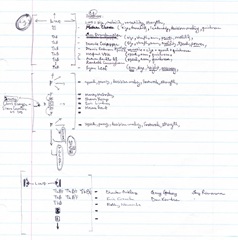
GAME-Blue-Formation-1

Module #1 power-speed formation depth chart:

SC:  Deron Williams (G, Utah Jazz), Kaká (MF, Real Madrid). This module’s position requires a strong decision maker with size, strength, quickness and the ability to distribute the ball precisely. The decisions that the SC make are based on the alignment and/or (expected) degree of penetration by the defense. Reacting to the defensive alignment, the SC will distribute the ball to the ThB’s in the rear, pass or lateral to the outside wings where wing playmakers (W) are aligned within separate wing modules, or keep the ball to achieve forward progress. Next in line: Derrick Rose (G, Chicago Bulls).

ThB: Tim Tebow (QB, University of Florida), Dan LeFevour (QB, Central Michigan University). This position requires a player who has the rare ability to accurately make all throws or kicks, run with elusiveness and run with power. Power is important in this position since the defense is aligned in close proximity. This ThB can either block/guard larger defenders, receive the ball and accurately distribute to ThB’s behind or to playmakers on the wings, or keep the ball to achieve forward progress. Next in line: Cam Newton (QB, Auburn University).

ThB: Terrelle Pryor (QB, Ohio State University), Dan Carter (Fly-half, USA Perpignan and the Crusaders), Juice Williams (QB, University of Illinois), . This position is similar to the ThB previously described, but throwing is not as essential of a requirement. The ability to pass or kick forward at this position is important in order to keep the defense off balance, but the majority of the time these ThB’s will keep the ball or distribute the ball laterally to a teammate. As a result, these ThB’s must have power, elusiveness and speed. Next in line: Jordan Reed (QB, University of Florida).

ThB: Boris Diaw (F/C, Charlotte Bobcats), Pau Gasol (C, Los Angeles Lakers). Diaw and Gasol are considered two of the best passing/outlet passing athletic big men in basketball. The primary physical attribute necessary for this position is size. As ThB’s are positioned further behind the frontline, visualizing the action on the field becomes more challenging. That is why it is necessary to have an excellent passing big man with good decision making skills positioned in the middle of the ThB formation to do the following: read the defensive formation and movement; analyze the progress of the ThB’s in the front (against the defense); adjust the call/play or continue with the planned call/play based on the two main reads; pass to the appropriate playmakers based on the reads. Next in line: Kevin Love (C, Minnesota Timberwolves).

ThB: Pat White (QB, Miami Dolphins), Seneca Wallace (QB, Seattle Seahawks). The next two rows of ThB’s are the best combination of speed, quickness and arm strength (or kicking accuracy with distance). Agile and elusive, these ThB’s can make plays with their game-breaking speed, with their arm strength or with their feet (if they are passing or scoring with kicks at the goal). They can get the ball to playmakers positioned on the wings, launch balls to playmakers in other nodes or dart into/out of nodes by using their speed to slice through zones.

ThB: Michael Vick (QB, Philadelphia Eagles), Denard Robinson (QB, University of Michigan). Next in line: Jonathan Brown (Centre half-forward, Brisbane Lions), Matthew Pavlich (Centre half-forward, Fremantle).

ThB: Donovan McNabb (QB, Philadelphia Eagles), Jay Cutler (QB, Chicago Bears. The next two rows of ThB’s have the best arms. This row has better movement and elusiveness than the following row; speed is not an essential attribute but a plus. The ability to throw the ball into other nodes and across zones is essential. Although these ThB’s may not have speed, they should have good lateral movement in order to laterally mirror the movements of ThB’s in the front rows (in the event ThB’s in front lateral, pass or kick to them) and the ability to laterally track the ThB’s behind them (in order to lateral, pass or kick to them). Next in line: Andrew Luck (QB, Stanford University).

…ThB: Ben Roethlisberger (QB, Pittsburgh Steelers), Joe Flacco (QB, Baltimore Ravens). Also known as “Towers” or “Throwers”, these ThB’s have size, strength and superb arm strength. Their goal is to fire balls to participants in other nodes, across zones or on the wings: to transition play into other nodes and zones; to advance the offense in their own zone of play. They may not exactly mirror the movements of the ThB’s in the front rows, but they must remain in the zone of action in order to receive a lateral, pass or kick. Next in line: Ryan Mallett (QB, University of Arkansas).